Django vs FastAPI in 2026: Which Python Framework to Choose?
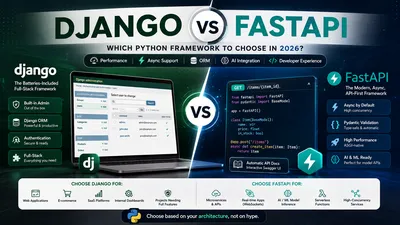
If you are building a web backend in Python in 2026, you are almost certainly choosing between two titans: Django and FastAPI.
While Flask still exists and newer microframeworks occasionally generate hype, Django and FastAPI have consolidated their dominance. But they represent fundamentally different philosophies of software architecture.
Django is the battle-tested, "batteries-included" full-stack framework. FastAPI is the modern, asynchronous, type-safe, API-focused framework. Choosing the wrong one won't just slow you down—it can dictate your hiring strategy, your cloud bill, and how easily you can integrate AI into your product.
Here is an engineer-focused breakdown to help you choose the right framework for your next project.
The 30-Second Answer
- Choose Django if you are building a traditional web application, a SaaS platform with heavy relational data, an e-commerce site, or anything where you need a robust admin panel, ORM, and authentication system out of the box.
- Choose FastAPI if you are building microservices, high-concurrency APIs, real-time applications (WebSockets), or wrapping Machine Learning/AI models for inference.
graph TD
    A[Python Backend] --> B{What is the primary goal?}
    B -->|Full App / SaaS / Admin Panel| C[Django]
    B -->|Microservices / AI Wrapper / High I/O| D[FastAPI]
    C --> E[Pros: Speed of dev, ORM, Security]
    D --> F[Pros: Async native, Pydantic typing, Speed]
Philosophy & Architecture
Django: The Batteries-Included Full-Stack Framework
Django was built in the early 2000s to help newsrooms publish content fast. Its philosophy is "don't repeat yourself" (DRY) and explicit is better than implicit.
When you install Django, you get an ORM, a database migration engine, an admin panel, an authentication system, form validation, and a templating engine. It is designed to help you build full applications quickly. While you can strip parts away (like using Django REST Framework to build a headless API), Django shines when you use its full stack.
FastAPI: The Async, API-First Framework
FastAPI was built for the modern asynchronous web. It is built on top of Starlette (for the web layer) and Pydantic (for data validation). It gives you routing and validation, and then gets out of your way.
There is no built-in ORM, no admin panel, and no templating engine. You assemble these yourself (usually using SQLAlchemy 2.0 and Alembic). It is designed for building APIs that handle high-concurrency I/O workloads.
Performance & Concurrency
In 2026, Python's performance landscape is shifting (thanks to the experimental free-threaded builds in Python 3.13+), but the fundamental I/O model of your framework still matters immensely.
- Django supports ASGI, async views, and asynchronous ORM operations. However, its async story is more constrained by its historically synchronous architecture and ecosystem. You can use async, but you have to be careful about blocking the event loop with older third-party packages.
- FastAPI was designed around ASGI and async from the beginning. It is particularly well suited to high-concurrency I/O-bound workloads, handling many concurrent network requests efficiently without blocking worker threads.
The Verdict: FastAPI is significantly better suited for high-concurrency I/O-bound tasks. Django is perfectly performant for the vast majority of standard web applications, but if you are building a real-time chat server or an API gateway handling massive concurrent traffic, FastAPI’s ASGI-native architecture makes it a strong option.
Developer Experience (DX) & Type Safety
Django's DX
Django prioritizes developer velocity. You can spin up a fully functional SaaS app with user authentication, password reset, and a database schema in an afternoon. The Django Admin panel alone saves weeks of development time for internal tools and B2B apps.
However, Django is dynamically typed. While you can add type hints, the framework doesn't enforce them at runtime to validate incoming API requests natively.
FastAPI's DX
FastAPI relies heavily on Python type hints. You define your data models using Pydantic, and FastAPI automatically: 1. Validates incoming JSON payloads. 2. Serializes outgoing responses. 3. Generates interactive Swagger/OpenAPI documentation automatically.
# FastAPI Example: Native validation and auto-documentation
from fastapi import FastAPI
from pydantic import BaseModel

app = FastAPI()

class UserCreate(BaseModel):
    email: str
    age: int

@app.post("/users")
def create_user(user: UserCreate):
    # Invalid values such as {"age": "twenty-five"} will fail validation
    # and FastAPI will automatically return a 422 error.
    # No need to write if/else validation blocks.
    return {"email": user.email, "age": user.age}
The Verdict: FastAPI offers an excellent developer experience for API-first development. The auto-generated docs and strict Pydantic V2 validation eliminate entire classes of bugs. Django requires Django REST Framework (DRF) to achieve similar API validation, which adds another layer of abstraction.
The 2026 Factor: AI & Machine Learning
Python is the lingua franca of AI, and how your web framework interacts with ML models is now a primary architectural decision.
FastAPI is particularly well suited to AI inference APIs. Its lightweight API-first design, async support, streaming responses, WebSockets, and Pydantic validation make it a natural choice for exposing ML models and LLM services.
Django is excellent for the business logic around AI. If you are building an AI SaaS, you still need to handle user subscriptions, rate limiting, database schemas for chat history, and an admin panel to manage users. Django can also serve AI-powered endpoints, especially when AI features are part of a larger application.
However, dedicated inference services often benefit from being separated from the main Django application so they can scale independently.
Django + FastAPI: Do You Actually Need Both?
Many projects shouldn't start with two frameworks. If you're building a new SaaS, don't automatically create a Django service, a FastAPI inference service, Redis, Kafka, Kubernetes, and six databases. Start with the simplest architecture that meets your requirements.
Here are three common patterns for 2026:
1. Normal SaaS (No heavy AI)
graph LR
    A[React / Next.js] --> B[Django / DRF]
    B --> C[(PostgreSQL)]
2. High-Concurrency API Service
graph LR
    A[Frontend / Clients] --> B[FastAPI]
    B --> C[(PostgreSQL)]
3. Larger AI SaaS (Hybrid)
graph LR
    A[Frontend] --> B[Django]
    B -->|Internal API / Queue| C[FastAPI AI Service]
    C --> D[(Model / LLM)]
    B --> E[(PostgreSQL)]
Note: If you use a hybrid approach, services can communicate through internal APIs or a message queue. In simpler deployments they may share infrastructure, while larger systems often give services clearer data ownership boundaries rather than sharing the exact same database tables.
Feature-by-Feature Comparison
| Feature | Django | FastAPI |
|---|---|---|
| Architecture | Full-stack web framework | API-focused web framework |
| Async | Supported | First-class / ASGI-native |
| ORM | Built-in Django ORM | None built-in (Usually SQLAlchemy 2.0) |
| Admin | Built-in, world-class | None built-in |
| Validation | Forms / DRF serializers | Pydantic |
| OpenAPI docs | Usually via API tooling/packages | Automatic |
| Best fit | Full applications & data-heavy SaaS | APIs, services & async workloads |
When to Choose What?
Choose Django if:
- You are building a data-heavy SaaS or CRM: The Django ORM and migrations are incredibly powerful for complex relational data.
- You need an Admin Panel: If you are building an internal tool or a B2B app where admins need to manage data, Django Admin saves months of work.
- You want everything in one box: Authentication, session management, CSRF protection, and security middleware are all configured out of the box.
Choose FastAPI if:
- You are building Microservices: Its lightweight footprint makes it perfect for small, focused services.
- You are wrapping AI/ML models: Its ability to handle async streaming and concurrent inference requests is ideal.
- You need maximum API performance: If your app is an API gateway or handles massive I/O, FastAPI's ASGI-native architecture is a strong option.
Frequently Asked Questions (FAQ)
Is FastAPI faster than Django? FastAPI is generally better suited for high-concurrency I/O-bound workloads. However, if your bottleneck is the database or CPU-bound calculations, the framework's raw routing speed matters less than your overall architecture and query optimization.
Can I use FastAPI with Django? Yes. A common pattern is to use Django as the core monolith for business logic and data models, and spin up a FastAPI microservice specifically for async tasks or AI inference. They can communicate via internal APIs or message queues.
Does FastAPI have an ORM? No. FastAPI is database-agnostic. Most modern FastAPI applications use SQLAlchemy 2.0 (which has excellent async support) with Alembic for migrations.
Is Django REST Framework (DRF) better than FastAPI? DRF is a powerful library for adding APIs to Django, but it carries the baggage of Django's historically synchronous architecture. FastAPI was built from the ground up for APIs. If your project is 100% an API (no server-rendered templates), FastAPI is generally the better choice.
Which is better for beginners? Django has more "magic" and conventions to learn (the "Django way" of doing things). FastAPI is more explicit and relies heavily on standard Python type hints. Many beginners find FastAPI easier to grasp initially, but Django's tutorials are incredibly comprehensive.
Conclusion
In 2026, the Django vs FastAPI debate isn't about which framework is "better"—it's about architecture.
If you are building a traditional application where developer velocity, relational data, and out-of-the-box tooling matter most, Django is usually the stronger choice. If you are building an API-first service, high-concurrency I/O workload, microservice, or dedicated AI inference API, FastAPI is often the better fit.
Choose your framework based on your product's I/O profile and your team's need for a full-stack structure versus API-first flexibility.
Related Articles
Firebase vs Supabase vs Convex (2025): Which Backend Should You Choose?
Jul 01, 2026
Razorpay Django Integration: Secure Payment Gateway with Signature Verification
Jun 29, 2026
Building a REST API from Scratch: A Step-by-Step Guide
Jun 25, 2026
Introduction to GraphQL: The Future of API Design
Jun 25, 2026