
A field guide for curious developers
Less scrolling.
More understanding.
Go beyond the answer. Explore practical guides, build real projects, and make the next concept click.
Build a Django Task Tracker, Part 4: Deploy with Gunicorn and Caddy
Move from a development server to an HTTPS deployment with environment settings, systemd, and operational checks.
Read the guideBuild a Django Task Tracker, Part 3: Test Permissions and Failure Cases
Test ownership, validation, pagination, template escaping, and CSRF with Django’s test client.
Read the guideBuild a Django Task Tracker, Part 2: Forms, Login and Ownership
Build a private task list with validated forms, owner-scoped queries, and CSRF-protected completion.
Read the guideThe reading room
More to discover
Build a Django Task Tracker, Part 1: Models and Migrations
Create a separate Django project, model task ownership, and apply your first migration.
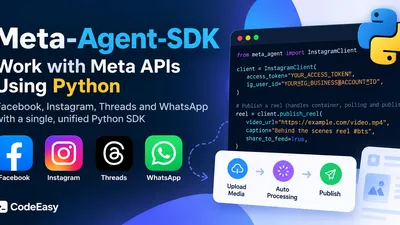
Meta-Agent-SDK: One Python Library to Rule Meta's Entire API Ecosystem
Meta-Agent-SDK is a modern Python library that brings Facebook, Instagram, Threads, and WhatsApp APIs together under a single, consistent interface. Learn how it simplifies publishing, comments, messaging, pagination, and Meta API automation with clean, typed Python code.
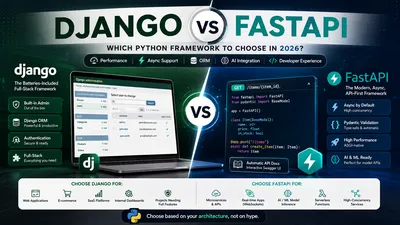
Django vs FastAPI in 2026: Which Python Framework to Choose?
Django or FastAPI—which Python framework should you choose in 2026? Compare architecture, performance, async support, ORM, AI integration, and developer experience to find the best fit for your next backend project.
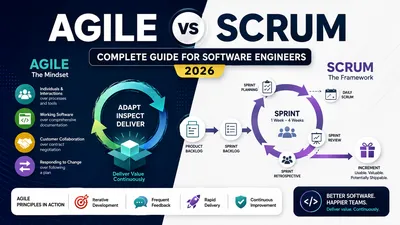
Agile vs Scrum: Complete Guide for Software Engineers (2026)
Learn the difference between Agile and Scrum from a software engineer’s perspective. Explore Sprints, Scrum accountabilities, events, artifacts, Kanban, real-world workflows, common anti-patterns, and interview questions.
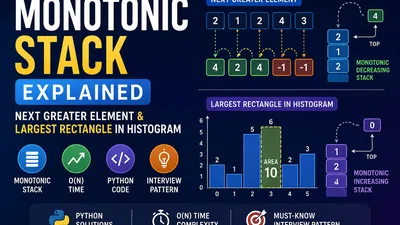
Monotonic Stack Explained: Next Greater Element & Largest Rectangle
Master the Monotonic Stack pattern used in top coding interviews. Learn how to solve Next Greater Element, Largest Rectangle in Histogram, and similar problems in O(N) time with intuitive explanations, Python examples, visual walkthroughs, and interview-ready techniques.
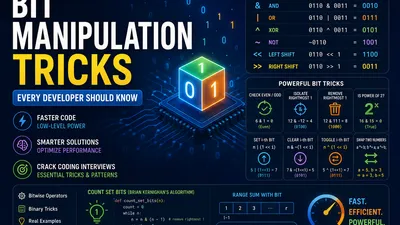
Bit Manipulation Tricks Every Developer Should Know (With Examples)
Master the most useful bit manipulation tricks used in coding interviews and competitive programming. Learn how bitwise operators work, perform fast binary operations, count set bits with Brian Kernighan’s algorithm, use bit masking, and solve common interview problems with clear explanations, practical examples, and a handy cheat sheet.
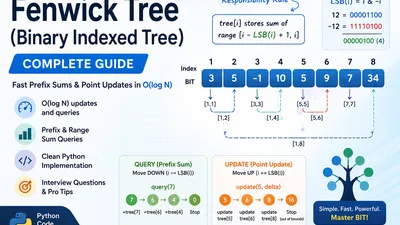
Fenwick Tree (Binary Indexed Tree): Complete Guide with Python, Diagrams & Interview Questions
Learn how the Fenwick Tree (Binary Indexed Tree) works with intuitive explanations, visual diagrams, and step-by-step examples. This complete guide covers the Least Significant Bit (LSB), point updates, prefix and range sum queries, Python implementation, complexity analysis, interview tips, and common mistakes to help you master one of the most important data structures for coding interviews and competitive programming.
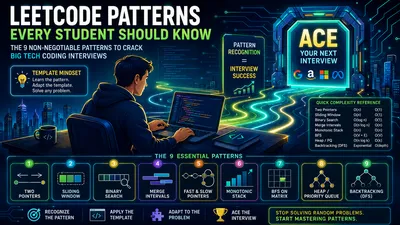
LeetCode Patterns Every Student Should Know (2026 Guide)
Stop solving LeetCode problems randomly. Learn the seven core coding patterns that power most interview questions at top tech companies. This guide covers Two Pointers, Sliding Window, Binary Search, BFS, DFS, Backtracking, Merge Intervals, and more, with practical examples and study strategies to help you recognize patterns instead of memorizing solutions.
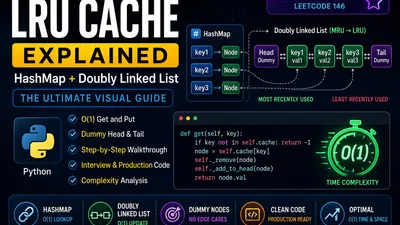
LRU Cache Explained: HashMap + Doubly Linked List (Python Guide)
Learn how the LRU (Least Recently Used) Cache achieves constant-time get and put operations by combining a HashMap with a Doubly Linked List. This guide includes Python implementations, visual explanations, interview pitfalls, production-ready alternatives using OrderedDict, and real-world applications in Redis, databases, browsers, and operating systems.

Oracle Cloud Free Tier (2026): The Ultimate Guide to Free Deployment
Oracle Cloud's Always Free Tier offers one of the most generous permanent free cloud platforms available. Learn how to deploy Docker, Node.js, PostgreSQL, and full-stack applications on OCI's ARM instances while avoiding common pitfalls like capacity errors, firewall issues, and account restrictions.
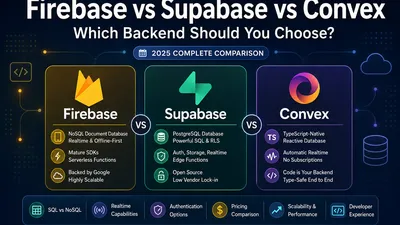
Firebase vs Supabase vs Convex (2025): Which Backend Should You Choose?
Compare Firebase, Supabase, and Convex across database architecture, real-time features, authentication, pricing, developer experience, scalability, and vendor lock-in to choose the right Backend-as-a-Service for your next project.
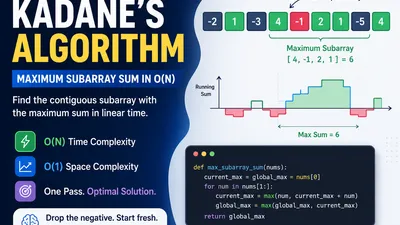
Kadane's Algorithm Explained: Maximum Subarray Sum in O(N)
Master Kadane's Algorithm with an intuitive explanation, visual walkthrough, Python implementation, and interview tips. Learn how this elegant dynamic programming technique finds the maximum subarray sum in O(N) time while handling tricky edge cases like all-negative arrays.
Put your knowledge to work
A good read is just the beginning.
Turn a new concept into something you can use.