Agile vs Scrum: Complete Guide for Software Engineers (2026)
URL: /agile-vs-scrum-guide-for-engineers
Meta Title:
Meta Description:
Category: Software Engineering & Culture
Focus Keyword: Agile vs Scrum, Scrum methodology, Agile methodology, Scrum framework
Agile vs Scrum: Complete Guide for Software Engineers (2026)
If you work in software development, you’ve probably heard the words "Agile" and "Scrum" used interchangeably. Teams "do Agile," have "Daily Scrums," and work in "Sprints."
But despite its ubiquity, Agile is widely misunderstood. Many companies claim to be Agile while still practicing "Waterfall in a trench coat"—delivering projects months late, ignoring customer feedback, and burning out developers.
To be an effective software engineer, you need to understand not just how to write code, but how that code gets shipped. Here is a practical, engineer-focused breakdown of Agile and Scrum methodologies, tailored for developers preparing for interviews and real-world team environments.
Agile vs Scrum: The Difference in 30 Seconds
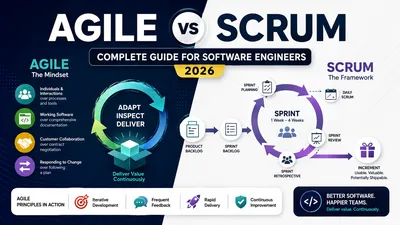
Before diving in, let's clear up the most common confusion: * Agile is a philosophy or mindset. It’s a set of values for software development. * Scrum is a framework. It is a specific set of rules and meetings (Sprints, Standups) used to implement the Agile philosophy.
If Agile is "eating healthy," Scrum is "the Mediterranean Diet."
graph TD
    A[Agile Mindset] --> B(Scrum)
    A --> C(Kanban)
    A --> D(Extreme Programming / Lean)
    B --> E[Sprints]
    B --> F[Accountabilities]
    B --> G[Events & Artifacts]
Why Waterfall Led to Agile
Before Agile became mainstream, many software projects followed plan-driven, sequential development approaches commonly described as Waterfall. You spent months writing a 200-page requirements document, then months designing the architecture, then months coding, and finally, months testing.
The fatal flaw? Requirements change. By the time the software was delivered, the market had moved, or the client realized what they asked for wasn't what they actually needed. Waterfall is predictive; it assumes you can know everything upfront.
What Is Agile Methodology?
While purists will point out that Agile is technically a philosophy rather than a strict methodology, the industry broadly refers to it as the Agile methodology.
Agile is adaptive. Instead of building the whole app at once, you build a small piece, show it to the user, get feedback, and adjust. You deliver value in small, continuous increments.
Born in 2001 with the Agile Manifesto, it prioritizes four core values:
- Individuals and interactions over processes and tools.
- Working software over comprehensive documentation.
- Customer collaboration over contract negotiation.
- Responding to change over following a plan.
Analogy: If Waterfall is building a house (you can't easily move a bathroom once the foundation is poured), Agile is building a Lego set. You build a small part, see if it looks right, and can easily swap pieces out if it doesn't.
What Is Scrum Methodology?
If Agile is the philosophy, Scrum methodology (or the Scrum framework) is the specific implementation. It breaks large projects into small, manageable chunks and structures the team around a strict cadence of planning, execution, and reflection.
flowchart TD
    A[Product Backlog] -->|Sprint Planning| B(Sprint Backlog)
    B --> C[The Sprint]
    C -->|Daily Scrum| C
    C -->|Sprint Review| D[Working Increment]
    D -->|Sprint Retrospective| E[Process Improvement]
    E -->|Next Cycle| A
How a Scrum Sprint Works
The core unit of Scrum is the Sprint—a timebox of one month or less (often 1–2 weeks in software teams) where the team focuses on a specific goal.
Once a Sprint starts, the scope shouldn't be changed in a way that endangers the Sprint Goal. However, scope can be clarified or renegotiated with the Product Owner as the team learns more. The goal isn't rigid adherence to a plan, but delivering a usable piece of software by the end of the timebox.
The 3 Scrum Accountabilities
The latest Scrum Guide shifted from using "Roles" to Accountabilities to emphasize that everyone is responsible for the team's success. A Scrum Team is typically 10 or fewer people.
1. Product Owner (The "What")
The PO represents the customer and the business. They own the Product Backlog. Their job is to decide what needs to be built, prioritize it by business value, and ensure the development team understands the requirements. * Engineer tip: A good PO makes tradeoff decisions. A bad PO just says "build everything by Friday."
2. Scrum Master (The "How")
The Scrum Master is a true leader who serves the Scrum Team and the larger organization. They don't assign tasks. Instead, they enforce the Scrum framework, facilitate meetings, and help the team identify and remove impediments. * Engineer tip: If your CI/CD pipeline is broken and you can't deploy, you flag it to the Scrum Master. They won't fix it themselves, but they will facilitate the conversation with DevOps and ensure the blocker is removed so you can keep coding.
3. The Developers (The "Doers")
The people who actually design, build, test, and ship the software. In Scrum, "Developer" refers to anyone doing the work, including QA engineers, designers, and backend/frontend devs. They are self-organizing—Developers decide how to turn selected Product Backlog items into a valuable Increment.
The 3 Scrum Artifacts
Artifacts ensure transparency across the team.
- Product Backlog: The master wishlist. It contains every feature, bug fix, and technical debt task needed for the product. It is constantly reprioritized by the Product Owner (this is called Backlog Refinement).
- Sprint Backlog: The specific subset of items from the Product Backlog selected for the Sprint, along with a plan for delivering them. The team commits to the Sprint Goal, while the specific work items are a forecast that can be adapted as the team learns more.
- The Increment: The usable Increment that meets the Definition of Done built during the Sprint. The Definition of Done (DoD) is a shared checklist ensuring the code meets quality standards (which might include testing, peer review, or deployment, depending on the team's agreement).
The 5 Scrum Events
Scrum is defined by its timeboxed meetings.
- The Sprint: The container for all other events (one month or less).
- Sprint Planning: The team looks at the Product Backlog, asks the PO questions, and decides which items they can realistically complete in the upcoming Sprint.
- The Daily Scrum (Standup): A 15-minute daily sync. A common format involves answering three questions: What did I do yesterday? What will I do today? Are there any blockers? (Note: This format is popular, but not strictly required by Scrum—the goal is simply to inspect progress and adapt the plan for the next 24 hours).
- Sprint Review: The team demos the Increment (working software) to the PO and stakeholders to gather feedback and adjust the Product Backlog.
- Sprint Retrospective: The team looks inward at their own process. What went well? What was frustrating? What can we change next Sprint to be 1% better?
Real Example: Building a Feature with Scrum
Let’s walk through how a team builds a "User Login" feature using Scrum. Notice how the work overlaps rather than happening in sequential phases.
timeline
    title Scrum Timeline for a Login Feature
    Backlog : PO writes "As a user, I want to log in via Google"
    Sprint Planning : Team forecasts 5 days of work. Sets Sprint Goal.
    Sprint (Day 1-2) : Dev scaffolds backend OAuth API & UI button simultaneously
    Sprint (Day 3-4) : Connect UI to API, write unit tests, manual testing
    Sprint (Day 5) : E2E testing, Peer Code Review, merge to main
    Sprint Review : Demo working login to stakeholders
    Retrospective : "Next time, let's involve QA even earlier"
Common Scrum Anti-Patterns (What Goes Wrong)
Many teams adopt the rituals of Scrum but fail to adopt the Agile mindset. Watch out for these red flags:
- Waterfall in a Sprint: The PO hands a massive, fully specified design document at Sprint Planning, Devs code it for 2 weeks, and QA tests it on the last day. Agile requires continuous testing and collaboration during the Sprint.
- The Scrum Master is a Taskmaster: If your Scrum Master is assigning tickets and telling you how to do your work, they are violating the self-organizing principle of Scrum.
- Zombie Standups: Spending 45 minutes deep-diving into a database schema bug during the Daily Scrum. Standups are for flagging blockers, not solving them. Take technical deep dives offline.
- No Definition of Done: A ticket is marked "Done" just because the dev finished typing. But it isn't tested or merged. "Done" means the work meets the Definition of Done and contributes to a usable Increment.
- Ignoring Tech Debt: The PO only prioritizes features. The codebase becomes a tangled mess. A healthy team should negotiate with the PO to allocate a sustainable portion of every Sprint to refactoring and technical debt, rather than letting it pile up indefinitely.
Agile vs Scrum vs Kanban
Scrum is not the only Agile framework. Kanban is another popular one, especially in DevOps and support teams.
| Feature | Scrum | Kanban |
|---|---|---|
| Cadence | Fixed length Sprints (1-4 weeks) | Continuous flow |
| Accountabilities | PO, Scrum Master, Devs | No required accountabilities |
| Key Metric | Sprint Goal delivery (Velocity is optional) | Lead time (Time from start to done) |
| Changes | Shouldn't endanger Sprint Goal | Can be reprioritized anytime |
| Best For | Product development, feature teams | Support, maintenance, DevOps |
Tip for Engineers: If you are building a new product feature, Scrum is usually better. If you are maintaining infrastructure or handling incoming support tickets, Kanban is better because it is purely flow-based.
Agile & Scrum Interview Questions
As a software engineer, you will almost certainly be asked about your experience with Agile/Scrum in behavioral interviews. Here are the top questions and how to answer them:
1. What is the difference between Agile and Scrum? Agile is a philosophy or mindset based on the Agile Manifesto. Scrum is a specific framework used to implement that philosophy.
2. What are the three Scrum accountabilities? Product Owner (maximizes value), Scrum Master (ensures effective Scrum practices), and Developers (create the increment).
3. What are the five Scrum events? The Sprint, Sprint Planning, Daily Scrum, Sprint Review, and Sprint Retrospective.
4. What is a Sprint? A fixed-length event of one month or less in which the Scrum Team works toward a Sprint Goal and creates a usable Increment that meets the Definition of Done.
5. Product Backlog vs Sprint Backlog? The Product Backlog is the master wishlist of everything needed for the product. The Sprint Backlog is the specific subset of items selected for the Sprint, along with a plan to achieve the Sprint Goal.
6. What is the Definition of Done (DoD)? A shared checklist the team agrees on to define when an increment is truly "done" (e.g., code written, tested, peer-reviewed).
7. Scrum vs Kanban? Scrum organizes work into fixed-length Sprints centered around a Sprint Goal. Scope can be adapted during a Sprint as long as the Sprint Goal isn't endangered. Kanban uses continuous flow and typically limits work in progress rather than organizing work into Sprints.
8. What happens if work isn't completed during a Sprint? The incomplete work is returned to the Product Backlog. The team discusses why it wasn't finished during the Retrospective, and the PO decides if it should be prioritized in the next Sprint.
9. Can Sprint scope change? Yes, but only if it doesn't endanger the Sprint Goal. Scope can be clarified or renegotiated with the Product Owner as the team learns more.
10. What does a Scrum Master actually do? They are a true leader who serves the team. They don't assign tasks. They facilitate ceremonies, remove impediments, and coach the team on Agile practices.
Frequently Asked Questions (FAQ)
Is Scrum the same as Agile? No. Agile is a mindset or philosophy outlined in the Agile Manifesto. Scrum is a specific framework that falls under the Agile umbrella to implement those values.
Is Scrum still used in 2026? Yes, Scrum remains widely used across enterprise and product-development teams. While frameworks like Kanban and Shape Up have grown in popularity, Scrum’s structure is still highly prevalent.
Can Scrum work without a Scrum Master? While a small, highly mature team might function without a dedicated Scrum Master, the accountability still needs to exist. Without someone actively removing impediments and protecting the process, teams often slip back into disorganized habits or Waterfall practices.
Is Kanban better than Scrum? Neither is universally better. Kanban is generally better for support, DevOps, or maintenance teams where work is continuous and unpredictable. Scrum is better for product development where you need fixed timeboxes to focus on delivering specific feature sets.
Conclusion
Agile is the mindset; Scrum is one implementation of that mindset.
Neither matters if a team simply goes through the motions—holding Daily Scrums and running Sprint Plannings—without actually delivering feedback-driven increments of working software. As a software engineer, your job isn't just to write code; it's to collaborate with the Product Owner to ensure you are building the right thing, and to use the Retrospective to constantly refine how you build it.