Bit Manipulation Tricks Every Developer Should Know (With Examples)
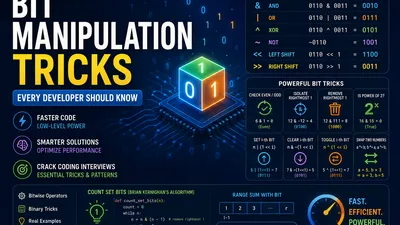
Bit manipulation is the act of algorithmically manipulating bits or memory addresses. While high-level languages like Python and Java abstract this away, bit operations happen at the hardware level, making them blazing fast.
In coding interviews and systems programming, bit manipulation is a recurring theme. Whether you are optimizing memory, implementing a Fenwick Tree, or trying to solve a problem without using extra space, knowing your bitwise operators is a superpower.
Here is a complete guide to the most essential bit manipulation tricks every developer should know.
The Core Bitwise Operators (A Quick Refresher)
Before we get to the tricks, ensure you know the basic operators. Let's use a fixed 4-bit system just for visualization.
| Operator | Name | Description | Example (A=6 (0110), B=3 (0011)) |
|---|---|---|---|
& |
AND | 1 only if both bits are 1 | 0110 & 0011 = 0010 (2) |
\| |
OR | 1 if either bit is 1 | 0110 \| 0011 = 0111 (7) |
^ |
XOR | 1 only if bits are different | 0110 ^ 0011 = 0101 (5) |
~ |
NOT | Inverts all bits | ~0110 = 1001 (See note below) |
<< |
Left Shift | Shifts bits left (adds 0s at end) | 0110 << 1 = 1100 (12) |
>> |
Right Shift | Shifts bits right (drops bits) | 0110 >> 1 = 0011 (3) |
⚠️ The NOT (
~) Operator Caveat: In a fixed 4-bit visualization,~0110becomes1001. However, in real programming languages like Python, Java, or C++, integers use two's complement representation with many more bits. Therefore,~6actually evaluates to-7, not9. The~operator flips all bits, including the sign bit.
Trick 1: Check if a Number is Even or Odd
The most basic bit manipulation trick. Instead of using the modulo operator (%), use the bitwise AND operator.
Why it works: The least significant bit (LSB) of an odd number is always
1. For an even number, it is0. ANDing the number with1isolates this LSB.
def is_odd(n):
    return (n & 1) == 1

# 5 (0101) & 1 (0001) = 1 (Odd)
# 6 (0110) & 1 (0001) = 0 (Even)
Trick 2: Multiply or Divide by 2
Shifting bits to the left multiplies a number by 2. Shifting right divides by 2.
Caveat: Left shifting by one bit is equivalent to multiplying by 2 for non-negative integers that do not overflow the integer type. In languages like C/C++, shifting out of bounds causes undefined behavior. In Python, integers have arbitrary precision, so they just grow larger.
n = 4
print(n << 1)  # Output: 8 (Multiply by 2)
print(n >> 1)  # Output: 2 (Divide by 2)
Trick 3: Isolate the Rightmost Set Bit (x & -x)
If you read our Fenwick Tree guide, you know this one! It isolates the lowest 1 bit of a number.
Why it works: Two's complement means
-xis essentially~x + 1. ANDingxwith-xzeroes out everything except the rightmost1. This is highly useful for calculating trailing zeros in algorithms.
x = 12  (1100)
-x = 4  (0100)

1100 & 0100 = 0100 (4)
Trick 4: Remove the Rightmost Set Bit (x & (x - 1))
This is arguably the most famous bit manipulation trick. It turns the rightmost 1 bit into a 0.
Why it works: Subtracting
1from a number flips all bits up to and including the rightmost1. ANDing this with the original number clears that bit.
x   = 12 (1100)
x-1 = 11 (1011)

1100 & 1011 = 1000 (8)
The Killer Application: This is the core of Brian Kernighan’s Algorithm, used to count the number of set bits (1s) in a number in $O(\text{number of 1s})$ time.
def count_set_bits(n):
    count = 0
    while n:
        n = n & (n - 1) # Removes the rightmost 1 bit
        count += 1
    return count

print(count_set_bits(15)) # 15 is 1111 in binary. Output: 4
Built-in Popcounts
In production code, you rarely write Brian Kernighan's Algorithm yourself. Modern languages have built-in popcount (population count) functions:
* Python 3.10+: n.bit_count() (e.g., 15.bit_count() returns 4)
* C++: __builtin_popcount(n)
* Java: Integer.bitCount(n)
However, interviewers still expect you to know how to implement it manually!
Trick 5: Check if a Number is a Power of 2
A power of 2 (like 2, 4, 8, 16) has exactly one 1 bit in its binary representation.
If we apply Trick 4 (x & (x - 1)), it will remove that single 1 bit, resulting in 0.
def is_power_of_two(n):
    if n <= 0:
        return False
    return (n & (n - 1)) == 0

print(is_power_of_two(16)) # True (10000 & 01111 = 0)
print(is_power_of_two(14)) # False (1110 & 1101 = 1100)
Trick 6: Bit Masking (Set, Clear, Toggle, Check, Extract)
When working with hardware, flags, or writing low-level algorithms (like Chess engines), you often need to manipulate specific bits at index i (0-indexed from the right).
Let mask = 1 << i (shift the 1 to the desired position).
- Extract the $i$-th bit:
(n >> i) & 1 - Check if the $i$-th bit is set:
(n & mask) != 0 - Set the $i$-th bit (make it 1):
n | mask - Clear the $i$-th bit (make it 0):
n & ~mask - Toggle the $i$-th bit:
n ^ mask
n = 5  # 0101

# Extract the 1st bit (index 1)
bit = (n >> 1) & 1  # Returns 0

# Set the 1st bit (index 1, which is currently 0)
n = n | (1 << 1)
print(n) # Output: 7 (0111)
Trick 7: Check if Two Numbers Have Opposite Signs
A very common interview trick. The sign bit is the leftmost bit (in fixed-width integers). If two numbers have different sign bits, XORing them will result in a negative number.
def opposite_signs(a, b):
    return (a ^ b) < 0

print(opposite_signs(5, -3)) # True
print(opposite_signs(-5, -3)) # False
Trick 8: Swap Two Numbers Without a Temporary Variable
A classic interview trivia question. You can swap two variables using XOR (^) without a temp variable.
Note: Although this is a classic interview trick, using a temporary variable is clearer in production code, and modern compilers optimize temporary variables effectively anyway.
a = 5
b = 3

a = a ^ b
b = a ^ b  # (a ^ b) ^ b = a
a = a ^ b  # (a ^ b) ^ a = b

print(a, b) # Output: 3 5
Complexity Analysis
| Operation | Time |
|---|---|
&, \|, ^ |
$O(1)$ |
<<, >> |
$O(1)$ |
| Brian Kernighan | $O(\text{number of set bits})$ |
Common Real-World Applications
"When do I actually use this?" Outside of LeetCode, bit manipulation is foundational to computer science:
* Permission Systems: Unix file permissions (rwx = 7) use bitmasking.
* Flags: Passing multiple boolean configurations to a function in a single integer.
* Chess Engines: Representing board states efficiently using 64-bit integers (Bitboards).
* Bloom Filters: Probabilistic data structures using bit arrays.
* Networking & Cryptography: Calculating checksums, hashes, and XOR ciphers.
* Compression: Huffman coding relies heavily on bit-level I/O.
Pattern Recognition: When to Use What
Instead of just memorizing tricks, learn to recognize the interview signals:
| If the question says... | Think about... |
|---|---|
| Count set bits / Hamming weight | n & (n - 1) or built-in bit_count() |
| Power of two | n & (n - 1) == 0 |
| Unique element appears once, others twice | XOR (^) |
| Toggle flags / Permissions | Bit masking (\|, &, ^) |
| Fast multiply/divide by 2 | Shift operators (<<, >>) |
| Large boolean state (e.g., tracking 1000 bools) | Bitmasking / Bitsets |
| Isolate rightmost bit | n & -n |
The Ultimate Bit Manipulation Cheat Sheet
Bookmark this table for quick reference:
| Operation | Formula | Example |
|---|---|---|
| Check if Even/Odd | n & 1 |
6 & 1 == 0 |
| Multiply by 2 | n << 1 |
4 << 1 == 8 |
| Divide by 2 | n >> 1 |
8 >> 1 == 4 |
| Isolate Rightmost 1 | n & -n |
12 & -12 == 4 |
| Remove Rightmost 1 | n & (n - 1) |
12 & 11 == 8 |
| Is Power of 2? | n > 0 and (n & (n-1)) == 0 |
16 & 15 == 0 |
| Extract $i$-th Bit | (n >> i) & 1 |
(5 >> 1) & 1 == 0 |
| Set $i$-th Bit | n \| (1 << i) |
5 \| (1<<1) == 7 |
| Clear $i$-th Bit | n & ~(1 << i) |
7 & ~(1<<1) == 5 |
| Toggle $i$-th Bit | n ^ (1 << i) |
5 ^ (1<<1) == 7 |
| Opposite Signs? | (a ^ b) < 0 |
(5 ^ -3) < 0 |
Real Interview Questions & Practice Problems
Bit manipulation problems are notoriously tricky to visualize but become easy once you apply the right trick.
| Difficulty | Problem | Platform |
|---|---|---|
| Easy | Number of 1 Bits | LeetCode |
| Easy | Missing Number | LeetCode |
| Medium | Single Number (XOR Trick) | LeetCode |
| Medium | Sum of Two Integers (No + or -) | LeetCode |
| Medium | Counting Bits | LeetCode |
| Medium | Bitwise AND of Numbers Range | LeetCode |
| Medium | Maximum XOR of Two Numbers in an Array | LeetCode |
| Medium | Reverse Bits | LeetCode |
Frequently Asked Questions (FAQ)
Why use bit manipulation when I can just use + or %?
In high-level languages, the compiler often optimizes arithmetic operations into bitwise operations anyway. However, bitwise operations are strictly necessary when dealing with raw memory, writing device drivers, implementing data structures like Tries or Fenwick Trees, or solving specific LeetCode puzzles that ban standard operators.
Is XOR (^) the same as Exponentiation?
NO. This is a massive beginner mistake, especially in Python (where ^ is XOR and ** is exponentiation). 2 ^ 3 is 1 (XOR), not 8 (Exponent).
How does the Sum of Two Integers work without + or -?
You use & to calculate the carry, and ^ to calculate the sum without carry. You loop until there is no carry left. (It's a great interview question to test your bit math!).
Related Articles
Monotonic Stack Explained: Next Greater Element & Largest Rectangle
Jul 21, 2026
Fenwick Tree (Binary Indexed Tree): Complete Guide with Python, Diagrams & Interview Questions
Jul 07, 2026
LeetCode Patterns Every Student Should Know (2026 Guide)
Jul 07, 2026
LRU Cache Explained: HashMap + Doubly Linked List (Python Guide)
Jul 02, 2026
Kadane's Algorithm Explained: Maximum Subarray Sum in O(N)
Jul 01, 2026