Introduction to GraphQL: The Future of API Design
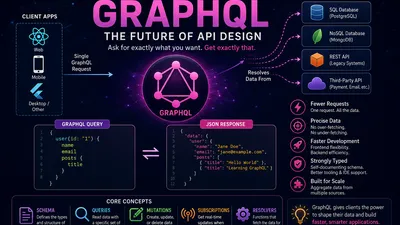
For decades, REST (Representational State Transfer) was the undisputed king of API design. If you wanted data from a server, you sent a request to a specific URL, and the server sent back a fixed block of data. But as web and mobile applications grew more complex, the cracks in REST began to show.
Enter GraphQL—a query language for APIs and a runtime for fulfilling those queries.
Developed internally by Facebook in 2012 and open-sourced in 2015, GraphQL was built to solve the exact problems modern applications face. In this article, we’ll explore what GraphQL is, why it was created, how it works, and why it has been adopted by giants like GitHub, Pinterest, and Shopify.
The Problem with REST
To understand why GraphQL exists, we first need to understand the frustrations of working with REST. RESTful APIs typically rely on multiple endpoints (e.g., /users, /posts, /comments). This leads to two major issues:
- Over-fetching: You need to display a user's name and profile picture, but the
/usersendpoint returns their entire profile—email, address, bio, and purchase history. You’re downloading data you don’t need, wasting bandwidth and slowing down the app. - Under-fetching: You need a user's profile and their latest posts. The
/usersendpoint doesn't include posts. So, you have to make a second request to/users/{id}/posts. This "waterfall" of network requests severely degrades performance, especially on mobile networks.
GraphQL solves both of these problems with a single philosophy: Ask for exactly what you want, and get exactly that.
What is GraphQL?
Despite the "QL" in its name, GraphQL is not a database query language like SQL. It is a query language for your API. It sits between the client (frontend) and your data sources (databases, microservices, legacy REST APIs), acting as a flexible middleman.
With GraphQL, instead of hitting multiple endpoints, you hit a single endpoint (usually /graphql) and send a query that describes the exact shape of the data you want.
A simple GraphQL query looks like this:
{
  user(id: "1") {
    name
    email
    posts {
      title
    }
  }
}
And the server returns JSON in the exact same shape:
{
  "data": {
    "user": {
      "name": "Jane Doe",
      "email": "jane@example.com",
      "posts": [
        { "title": "Hello World" },
        { "title": "Learning GraphQL" }
      ]
    }
  }
}
No over-fetching, no under-fetching. You got the user's info and their posts in a single request.
The Core Concepts of GraphQL
To work with GraphQL, you need to understand its foundational building blocks.
1. The Schema
The schema is the heart of any GraphQL server. It defines the "contract" between the client and server. Written in the Schema Definition Language (SDL), it specifies what types of data exist and how they relate to each other.
type User {
  id: ID!
  name: String!
  email: String!
  posts: [Post]
}

type Post {
  id: ID!
  title: String!
  author: User!
}
(The ! means the field is required/non-nullable).
2. Queries (Read)
A Query is how a client reads data. It is the equivalent of a GET request in REST. You define a query operation and specify the fields you want returned.
3. Mutations (Write)
A Mutation is how a client modifies data (create, update, delete). It is the equivalent of POST, PUT, or DELETE in REST. After a mutation, the client can also query the updated data in the same request.
mutation {
  createUser(name: "John", email: "john@example.com") {
    id
    name
  }
}
4. Subscriptions (Real-time)
Subscriptions allow clients to listen to real-time data updates. When data changes on the server, the server pushes the update to the client, usually over WebSockets. This is perfect for chat applications or live dashboards.
5. Resolvers
If the Schema defines what data exists, Resolvers define how to get it. A resolver is a function that fetches data for a specific field. For example, the resolver for the posts field on a User might query your PostgreSQL database, while the resolver for email might hit a third-party API.
The Benefits of GraphQL
- Fewer Network Requests: By combining data from multiple resources into one query, mobile apps load significantly faster.
- Rapid Product Iteration: Frontend developers don't need to ask backend developers to create a new endpoint every time a new UI component requires slightly different data. They just change the query.
- Strong Typing & Self-Documenting: Because the schema strictly defines data types, developers know exactly what to expect. Tools like GraphiQL or Apollo Explorer can auto-generate documentation and provide autocomplete for queries.
- Aggregation of Microservices: GraphQL can act as an API Gateway. You can fetch user data from one microservice and billing data from another, merging them seamlessly into a single GraphQL response.
When GraphQL Might Not Be the Best Fit
GraphQL is incredibly powerful, but it’s not a silver bullet. Here are a few reasons you might stick with REST:
- Caching is Harder: REST leverages HTTP caching natively (using URLs as cache keys). Because GraphQL uses a single endpoint, you need to implement more complex caching strategies on the client side (like Apollo Cache) or use tools like Persisted Queries.
- The N+1 Problem: If a query asks for an author and their 10 posts, a naive GraphQL server might make 11 database queries (1 for the author, 10 for each post). This is solved using DataLoader batching, but it requires careful backend engineering.
- File Uploads: GraphQL doesn't natively handle file uploads well. Most developers still use REST endpoints or pre-signed URLs (like AWS S3) for file transfers alongside their GraphQL API.
- Simple Apps: If you are building a simple CRUD app, setting up GraphQL schemas, types, and resolvers is overkill. REST will get you to market faster.
Conclusion
GraphQL represents a paradigm shift in API design. It shifts the power from the server (which dictates data structure in REST) to the client, allowing applications to fetch precisely the data they need, when they need it.
While it comes with a learning curve and requires careful backend optimization to avoid performance pitfalls, the benefits for complex, data-heavy applications are undeniable. Whether you are building the next big social network or simply tired of maintaining a dozen REST endpoints for a single page, GraphQL is a technology well worth learning.
Related Articles
Django vs FastAPI in 2026: Which Python Framework to Choose?
Aug 04, 2026
Firebase vs Supabase vs Convex (2025): Which Backend Should You Choose?
Jul 01, 2026
Razorpay Django Integration: Secure Payment Gateway with Signature Verification
Jun 29, 2026
Building a REST API from Scratch: A Step-by-Step Guide
Jun 25, 2026