The Ultimate Software Engineer Resume Guide (2026): Build an ATS-Friendly Resume That Gets Interviews
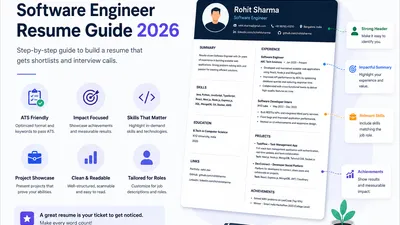
Your resume has one job: To get you the interview. It is not an autobiography; it is a marketing document.
At top tech companies (FAANG, unicorns, high-growth startups), a recruiter spends an average of 6 to 10 seconds on your resume before making a decision. Furthermore, before a human ever sees it, your resume must pass through an ATS (Applicant Tracking System)—a parser that scores your resume based on keywords and structure.
If your resume reads like a list of chores, you will be rejected. If it reads like a list of achievements, you will get the interview. Here is the definitive guide to building a high-scoring SDE resume.
Rule 1: Master the ATS Formatting
ATS software is stupid. If you use a fancy Canva template with columns, sidebars, graphics, or custom fonts, the parser will scramble your text or outright reject it.
The Golden Rules of ATS Formatting:
1. Single Column: No sidebars. Left-to-right, top-to-bottom reading order.
2. Standard Fonts: Arial, Calibri, Garamond, or Roboto. Size 10-12pt.
3. Standard Headings: Use exactly "Experience", "Education", and "Skills". Don't use "Where I've Been" or "My Journey". The ATS looks for specific heading tokens.
4. No Images/Icons: The ATS cannot read icons for your phone number or GitHub. Use text.
5. Date Formatting: Month Year - Month Year (e.g., Jan 2022 - Present). Don't use 2022.01 - Current.
6. File Type: Always submit as a PDF (unless the application explicitly asks for a Word Doc). This freezes your formatting in place.
graph TD
    A[Resume Submitted] --> B{ATS Parser}
    B -->|Fails to Parse| C[Auto-Reject]
    B -->|Parses Successfully| D[Keyword Scorer]
    D -->|Score < Threshold| C
    D -->|Score > Threshold| E[Human Recruiter]
    E -->|6 Second Glance| F{Interview?}

    style C fill:#f96,stroke:#333
    style F fill:#4CAF50,color:#fff
Rule 2: The XYZ Formula for Bullet Points
The single biggest mistake developers make is writing bullet points that describe their responsibilities instead of their impact.
The Google-Approved XYZ Formula:
"Accomplished [X] as measured by [Y], by doing [Z]."
- X = What you did (The Impact/Result)
- Y = The Metric (Quantifiable Evidence)
- Z = How you did it (The Technical "How")
Let's look at the transformation:
❌ Weak (Responsibility):
Built a caching layer for the API.
✅ Strong (Impact via XYZ):
Reduced API p95 latency by 40% and cut database load by 60%, by implementing a Redis caching layer with TTL-based invalidation.
❌ Weak (Responsibility):
Migrated the monolith to microservices.
✅ Strong (Impact via XYZ):
Improved deployment frequency from bi-weekly to daily and reduced CI build times by 30%, by decomposing the legacy monolith into 4 Go-based microservices orchestrated via Kubernetes.
"But I don't have metrics!"
If you don't know the exact number, make an educated, defensible estimate. * Did it save time? "Saved the team ~5 hours/week of manual QA..." * Did it handle scale? "Designed to support 10,000 concurrent users..." * Did it reduce errors? "Decreased user-reported rendering bugs by roughly half..."
Rule 3: Section-by-Section Breakdown
1. Header (Keep it tight)
- Name (Large font)
- Location (City, State is fine. No full street address)
- Phone | Email | LinkedIn | GitHub | Portfolio/Website
2. Experience (The Core)
Reverse chronological order. For each role: * Company Name | Title | Dates * 3 to 5 Bullet Points. (Senior devs: 5 points. Juniors: 3-4 points). * The First Bullet is the most important. It's the one the recruiter's eye will land on in their 6-second scan. Put your biggest, most quantifiable win there.
3. Skills (The Keyword Goldmine)
The ATS scans this section heavily. Categorize them for easy reading. Do not lie—if it's on your resume, you should be able to answer interview questions about it. * Languages: Python, Go, Java, SQL, C++ * Frameworks/Libraries: FastAPI, Django, React, Gin * Cloud/Infrastructure: AWS (EC2, S3, Lambda), Docker, Kubernetes, Terraform * Databases/Tools: PostgreSQL, Redis, Kafka, Git, Datadog
4. Projects (Crucial for Juniors, Optional for Seniors)
If you have less than 3 years of experience, personal/open-source projects are your lifesaver. Treat them like jobs. Use the XYZ formula. * Project Name | Tech Stack | Link * Example: "Built a real-time chat app supporting 500 concurrent connections using WebSockets and Go, reducing message delivery latency by 200ms compared to long-polling."
5. Education
Keep it brief. GPA is only relevant if you are a recent grad and it's above 3.5. * Degree, Major | University | Year * Relevant Coursework: (Only include if the job specifically aligns with it, e.g., Distributed Systems, Machine Learning).
Rule 4: The 2026 SDE Context (Standing Out)
The market is tougher now than it was five years ago. To stand out, your resume must reflect the modern engineering landscape. Sprinkle these concepts into your XYZ bullet points:
- AI Fluency: If you used AI tools to boost productivity, mention it. "Accelerated feature delivery by 20% by integrating GitHub Copilot into the CI workflow for boilerplate generation." (Shows you are a "Centaur Developer").
- Cloud-Native & Scale: Don't just say you used AWS. Be specific. "Provisioned infrastructure using Terraform..." or "Reduced AWS compute costs by 25% by migrating from EC2 to Lambda...".
- Observability: Show you care about code in production. "...integrated OpenTelemetry tracing to reduce Mean Time To Resolution (MTTR) by 40%."
- Security: "...implemented OWASP top 10 security standards and automated SAST scanning in GitHub Actions."
The 6-Second Resume Test
Before you submit your resume, try this exercise. Set a timer for 6 seconds. Look at your resume. When the timer goes off, ask yourself:
- Can I immediately tell what roles this person is targeting?
- Can I see at least one massive, quantifiable impact they made?
- Are the tech stacks clearly visible?
If the answer to any of those is "No," you need to rewrite. Your resume should not be a list of tasks you were assigned; it should be a highlight reel of the value you created.