Go (Golang) VS Python for full-stack development
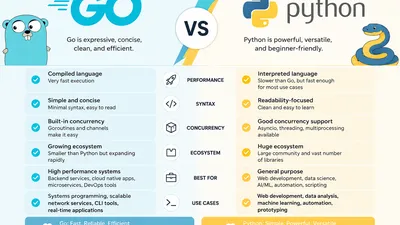
Choosing between Go (Golang) and Python for full-stack development involves a trade-off between performance and scalability (Go) versus speed of development and ecosystem richness (Python).
While neither language is traditionally associated with frontend web development (that remains the domain of JavaScript/TypeScript), both have mature backends and unique approaches to handling the frontend.
Here is a comprehensive breakdown of Go vs. Python for full-stack development.
1. Backend Development
Python: Python dominates the backend landscape. Frameworks like Django (batteries-included, monolithic) and FastAPI (modern, async, microservices) allow developers to spin up robust APIs incredibly fast. Python's dynamic typing means less boilerplate, but it also means more runtime errors.
Go: Go was built by Google to solve backend problems at scale. Its standard library is so powerful that many developers don't even use external frameworks. However, frameworks like Gin, Fiber, and Echo are popular for routing and middleware. Go's strict static typing and compiler catch errors before the code ever runs.
- 🏆 Winner: Python for speed of development and ecosystem; Go for raw performance, type safety, and handling massive concurrent traffic.
2. Frontend Development
Neither Go nor Python runs natively in the browser. To be "full-stack," you must choose a paradigm:
- The API Approach: Both languages excel at serving JSON APIs to a React, Vue, or Svelte frontend.
- Server-Side Rendering (SSR): Python uses templating engines like Jinja2 (built into Django). Go uses standard library templates (
html/template). - The HTMX Revolution: Lately, both languages have embraced HTMX to build interactive UIs without writing JavaScript. Go pairs exceptionally well with HTMX (e.g., using Templ), allowing you to build dynamic single-page-app-like experiences entirely in Go.
(Note: Go can compile to WebAssembly (WASM), and Python can use Pyodide, but running either in the browser for UI is currently a niche, experimental approach).
- 🏆 Winner: Tie. Both rely heavily on JS for frontend, but Python's Django templates are slightly easier for rapid prototyping, while Go+HTMX is currently a trendy, high-performance combo.
3. Performance & Concurrency
Python: Python is notoriously slow. While FastAPI utilizes asynchronous I/O (asyncio) to handle many concurrent network requests, CPU-bound tasks will bottleneck without multiprocessing. The GIL (Global Interpreter Lock) prevents true multi-threading.
Go: Go is a compiled language that runs close to the metal. Its secret weapon is Goroutines—lightweight virtual threads managed by the Go runtime. You can spawn hundreds of thousands of Goroutines without crashing your server. Concurrency is baked into the language's DNA.
- 🏆 Winner: Go. It’s not even close. Go is built for high-concurrency, low-latency backends.
4. Ecosystem & Third-Party Libraries
Python: Python's ecosystem is the largest in the world. Whether you need an ORM, a payment gateway integration, a PDF parser, or web-scraping tools, there is a battle-tested Python library for it.
Go: Go's ecosystem is excellent for cloud infrastructure, networking, and DevOps (Docker and Kubernetes are written in Go). However, for general business logic, you will occasionally find that a niche integration requires you to write your own package or bind to a C library, whereas Python already has a pip package for it.
- 🏆 Winner: Python.
5. The AI/ML Factor
Python: Python is the undisputed king of Artificial Intelligence, Machine Learning, and Data Science. If your full-stack app involves AI agents, LLM integrations (LangChain, OpenAI APIs), or data processing, Python will save you weeks of work.
Go: Go has some AI/ML libraries, but the community is years behind Python. Most Go developers calling AI models do so by making HTTP requests to Python microservices.
- 🏆 Winner: Python.
6. Developer Experience (DX) & Maintenance
Python: Python is famously readable and resembles pseudo-code. It is incredibly fast to write. However, refactoring a large Python codebase can be terrifying because a typo might not reveal itself until the code hits production.
Go: Go is verbose. Error handling requires explicit checks (if err != nil), and there is less "magic" happening under the hood. This makes Go slightly slower to write, but infinitely easier to maintain and refactor. The compiler forces you to handle edge cases.
- 🏆 Winner: Python for writing; Go for maintaining.
7. Deployment & DevOps
Go: Go compiles to a single static binary. You don't need to install dependencies, runtime environments, or virtual machines on your server. You just upload the binary and run it. This results in tiny Docker images (often under 20MB) and lightning-fast deployments.
Python: Deploying Python requires managing virtual environments, requirements.txt or poetry.lock, and ensuring the OS-level dependencies match. Docker images are usually hundreds of megabytes.
- 🏆 Winner: Go.
Summary Comparison Table
| Feature | Go (Golang) | Python |
|---|---|---|
| Typing | Statically typed, compiled | Dynamically typed, interpreted |
| Performance | Very fast (close to C/C++) | Slow |
| Concurrency | Excellent (Goroutines) | Difficult (GIL limits threading) |
| Backend Frameworks | Gin, Echo, Standard Library | Django, FastAPI, Flask |
| Frontend Approach | API / HTMX / Templates | API / HTMX / Django Templates |
| AI/ML Integration | Poor (calls Python APIs) | Excellent (Native) |
| Deployment | Single binary, very easy | Virtualenvs, dependencies, complex |
| Learning Curve | Moderate (concurrency concepts) | Low (very readable) |
The Verdict: Which should you choose?
Choose Python if: * You are building an MVP or prototype and need to move fast. * Your application heavily integrates AI, Machine Learning, or Data Science. * You want a "batteries-included" experience (Django) where the admin panel, ORM, and auth are set up out-of-the-box. * You are a solo founder or small team that prioritizes development speed over computational efficiency.
Choose Go if: * Your application requires high throughput and low latency (e.g., real-time chat, high-traffic APIs, streaming). * You want the safety of static typing and a compiler that catches bugs before deployment. * You are building microservices or cloud-native applications. * You want to embrace the Go + HTMX paradigm to build a modern, high-performance full-stack app without writing JavaScript APIs.
The Hybrid Approach (Common in Tech Companies): Write your data-heavy, AI-driven, or computationally simple backend APIs in Python (FastAPI). Write your high-traffic gateway, authentication, and real-time microservices in Go. Let React/TypeScript handle the frontend.