AI Won't Replace Software Developers — Developers Who Use AI Will (The 2026 Reality)
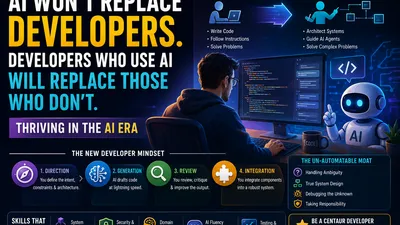
There is a palpable anxiety in the air among software developers. Every week, a new AI demo goes viral—writing an entire app from a prompt, solving LeetCode hards in seconds, or autonomously fixing GitHub issues. The question echoing across Slack channels and Reddit forums is legitimate: “Will AI replace me?”
The short answer is no. The longer, more nuanced answer is: AI won’t replace software developers, but developers who leverage AI will replace those who don’t.
The role of the software developer is not dying; it is undergoing a profound metamorphosis. We are transitioning from being Syntax Translators (turning explicit human instructions into code) to System Orchestrators (directing AI agents to build components while we architect the whole).
Here is what it actually means to be a software developer in the current AI era, and how to thrive in the shift.
The End of the "Code Monkey" Era
For the last two decades, a significant portion of software development involved rote work: writing boilerplate, searching StackOverflow for regex patterns, writing CRUD endpoints, and manually converting JSON payloads.
AI is exceptionally good at this. Tools like GitHub Copilot, Cursor, and Claude have essentially automated the "typewriter" phase of programming. If your primary value as a developer was your ability to type syntax quickly and memorize standard library APIs, that value is rapidly approaching zero.
But here is the paradox: as writing code becomes cheaper and faster, the demand for software engineering thinking actually increases. When code costs nearly nothing to produce, companies will want to build much more of it.
graph LR
    A[Then: High Cost of Code] --> B[Careful planning, less experimentation]
    C[Now: Low Cost of Code] --> D[Massive iteration, higher complexity]

    D --> E[Need for strong Architecture & Guardrails]
The New Developer Workflow: From Writer to Editor
The AI era changes the ratio of how we spend our time. Previously, a developer spent 80% of their time writing code and 20% reviewing or debugging it. Today, that ratio is inverting.
You are no longer solely an author; you are an Editor and Director.
- The Prompt (Direction): You define the intent, the constraints, and the architecture.
- The Generation (Drafting): The AI produces the first pass at speed.
- The Review (Editing): You read, critique, and fix the AI's output. This requires a higher level of skill than writing it from scratch. Spotting a subtle race condition or a security vulnerability in generated code demands senior-level scrutiny.
- The Integration (Orchestration): You stitch the AI-generated components into a cohesive, secure, and scalable system.
💡 The "Vibe Coding" Trap: Andrej Karpathy recently coined "vibe coding"—writing code by just prompting AI and accepting the output without fully understanding it. This is fine for weekend prototypes. In production, "vibe coding" leads to unmaintainable spaghetti, security holes, and systemic failures. You must understand the code you ship.
The Un-Automatable Moat: What AI Can't Do
LLMs are fundamentally prediction engines. They predict the next most likely token based on their training data. Therefore, they struggle profoundly with:
1. Handling Ambiguity
Product managers don't write perfect specifications. Users behave irrationally. Edge cases emerge in production. A developer's core job is taking a fuzzy, contradictory business problem and distilling it into a logical system. AI cannot ask the PM, "Did you mean for the user to be logged out when they perform this action on a secondary device?"
2. True System Design
AI can write a microservice. It cannot design a distributed architecture that accounts for eventual consistency, organizational team boundaries, data gravity, and cost optimization at scale.
3. Debugging the Unknown
AI is great at fixing a syntax error or a standard null pointer. It is terrible at figuring out why Service A and Service B are experiencing a deadlock only on Tuesdays at 2 PM due to an obscure interaction with a legacy database driver. Debugging requires tracing the unknown, forming hypotheses, and observing live systems—skills that require agency and context.
4. Taking Responsibility
When the database gets dropped, or a GDPR violation occurs, the AI cannot take the blame. Companies hire humans to be accountable.
The 202x Developer Stack: Skills You Must Cultivate
To thrive, you need to pivot your skillset toward the periphery of the software development lifecycle—where human judgment is paramount.
- System Architecture: When AI writes the components, you must design the boundaries. Study distributed systems, data flow, and coupling.
- Security & Compliance: AI models are trained on open-source code, much of which is insecure. They will confidently suggest SQL injection vulnerabilities. You are the last line of defense.
- Domain Expertise: Deep knowledge of finance, healthcare, logistics, or whatever domain you work in is your ultimate moat. AI doesn't understand why a business rule exists, only that it exists.
- AI Fluency (Prompt Engineering): Knowing how to context-load an LLM, how to chain prompts, and when to use agentic frameworks (like LangChain or AutoGPT) is the new baseline literacy.
- Testing & Observability: If you are generating code 10x faster, you must validate it 10x faster. Mastering TDD, contract testing, and observability tools (Datadog, OpenTelemetry) is non-negotiable.
The Centaur Developer
In chess, after AI beat the world champion Garry Kasparov, a new category emerged called "Centaur Chess"—where a human and AI play together as a team. For years, the Human+AI team consistently beat standalone AI and standalone humans.
We are entering the era of the Centaur Developer.
The most effective engineer in 2026 will not be the one who refuses to use AI out of pride, nor the one who blindly copies ChatGPT output. It will be the developer who uses AI to offload the tedious mechanics of coding, freeing up their cognitive bandwidth to focus on architecture, business logic, and complex problem-solving.
The code is no longer the artifact. The system is the artifact. The code is just the exhaust.
Stop worrying about AI taking your job, and start focusing on how to use AI to do the parts of your job you hate—so you can focus on the parts that actually matter.