How to Negotiate Your SDE Offer: A Complete Guide
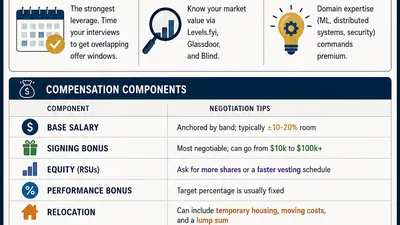
Negotiating a Software Development Engineer (SDE) offer can feel daunting, but it is an expected part of the hiring process in the tech industry. Companies rarely give their best offer first, and failing to negotiate leaves money—and leverage—on the table.
Here is a complete, step-by-step guide to negotiating your SDE offer, specifically tailored for the tech industry.
Phase 1: Preparation (Before the Offer)
Negotiation is 80% preparation and 20% execution. You must know your market value before you ever speak to a recruiter.
1. Understand the Tech Compensation Stack SDE compensation is not just a base salary. It consists of multiple "levers" you can negotiate: * Base Salary: Fixed yearly cash. * Sign-on Bonus: One-time cash, usually to make up for unvested equity at your current company or to bridge a gap in base salary. (Highly negotiable). * Equity (RSUs or Options): The long-term wealth builder. Vesting usually happens over 4 years with a 1-year "cliff" (you get nothing until your 1-year anniversary, then 25%, followed by monthly/quarterly vesting). * Annual Bonus: Target % of base salary (often tied to personal and company performance). * Level/Title: Negotiating a higher level (e.g., SDE II instead of SDE I) significantly raises your base, equity, and bonus bands.
2. Do Market Research Tech compensation varies wildly by company tier, location, and tech stack. * Levels.fyi: The gold standard for Big Tech compensation data. Look up the exact company and level. * Glassdoor/Blind: Good for broader context, though Blind can skew negative. * Determine your Market Rate (the average for your experience) and your Walk-Away Number (the minimum you will accept).
3. Deflect the "Salary Expectation" Question Recruiters will try to anchor you early by asking, "What are your salary expectations?" * The Deflection: "Right now, I’m most focused on the role and the team. I’d love to learn more about the position before discussing numbers." * If they push: "I’m looking for market-competitive compensation for this level, but I’m flexible depending on the total package." * If they force a number: Give a wide range based on your research, but state it as total compensation (Base + Equity + Bonus), not just base.
Phase 2: Receiving the Offer
1. Always Get It in Writing Never negotiate verbally. Get the full offer in writing so you can review the vesting schedule, benefits, and exact numbers.
2. Express Gratitude, Then Pause "Thank you so much! I’m thrilled about the opportunity to join the team. I need to review the details and discuss with my family/partner. Can I get back to you by [Day of week]?" * Why? It shows you are excited, buys you time, and prevents you from making rushed decisions or revealing your immediate thoughts.
3. Evaluate the Total Package Calculate the Total Year 1 Compensation (TC1) and Total Yearly Compensation (TC). * Example: $150k Base + $50k Sign-on + $100k RSUs (vesting 25/25/25/25) = $225k TC1, but $175k TC in years 2-4.
Phase 3: The Negotiation
Approach this as a collaborative problem-solving exercise, not a battle. You and the recruiter both want you to join.
1. Anchor High Your counteroffer should be at the top end of the market band for your level (or the band above you). It’s easier to negotiate down than up.
2. Use the "Competing Offer" Leverage (The Most Powerful) The best way to negotiate is with a real competing offer. * Script: "I’m really excited about your company, but I have another offer from [Company B] that is offering [X Base, Y Equity]. I would prefer to join your team, but the financial gap is hard to ignore. Is there anything you can do to close that gap?"
3. If You Don’t Have Competing Offers (Use Market Data) * Script: "Based on my research on Levels.fyi and my experience in [specific tech/skill], I was expecting compensation closer to [X Base, Y Equity]. Is there flexibility to bring the offer closer to that range?"
4. Negotiate the Levers (Don't Just Fixate on Base) Big Tech companies (FAANG) have strict base salary bands. If they say "Base is maxed out," pivot to other levers. * Script: "I understand the base is capped. Could we look at increasing the Sign-on bonus or the RSU grant to bring the total compensation in line with my expectations?"
5. Ask the "Why" Question If they say no to a request, don't get defensive. Ask for context. * Script: "I appreciate the transparency. Can you help me understand how the team arrived at this specific equity number?" (This forces them to justify their logic, which sometimes reveals flexibility).
Phase 4: Specific Scenarios & Tactics
- Negotiating with Startups: Startups have less cash but more equity. Ask about the strike price for options, the 409a valuation, and the company's latest valuation to understand what your equity is actually worth. You can also negotiate for faster promotion timelines or remote work flexibility.
- The "Exploding Offer": A company gives you 48 hours to accept or the offer vanishes. Tactic: Push back gently. "I’m very interested, but I have other commitments in my interview pipeline and I want to honor those. Can we extend the deadline to Friday?" Most companies will extend it if you are a strong candidate.
- The "One More Thing" Trap: Do not keep coming back with new demands. You get one counteroffer, maybe two. If you agree to a number, stick to it. Asking for more after saying yes burns bridges.
- Getting Leveled Down: If they offer you SDE I instead of SDE II, negotiate your sign-on and equity to match the bottom band of the SDE II role.
Phase 5: The Golden Rules (Do's and Don'ts)
✅ DO keep an upbeat, positive tone throughout. Emphasize that you want to join. ✅ DO leverage competing offers, even if they are from lesser companies. ✅ DO practice your scripts with a friend or mentor before calling the recruiter. ✅ DO be prepared to walk away if the offer is below your walk-away number.
❌ DON'T lie about competing offers. Recruiters talk, and lying can cost you the job. ❌ DON'T give personal reasons for needing more money (e.g., "My rent went up," "I have student loans"). Companies pay for market value, not your cost of living. ❌ DON'T negotiate just for the sake of it if it's your dream company and the offer is already at the top of the band. Know when you've won. ❌ DON'T accept the offer and then continue to interview elsewhere. Once you accept, pull out of all other pipelines.
Final Thought: The worst thing a recruiter can say is "No." You will rarely lose an offer just for asking for more money respectfully. As an SDE, your skills are in high demand—remember your worth.