System Design Patterns for Microservices Architecture: A Complete Guide
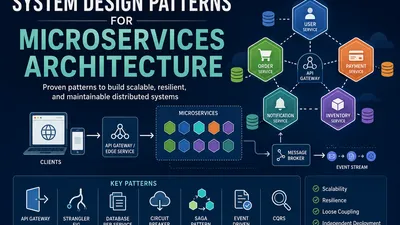
Moving from a monolith to microservices is like moving from a single-family home to a sprawling apartment complex. Suddenly, you don't just worry about keeping the house standing; you have to worry about plumbing between buildings, intercom systems, power grids, and what happens when one apartment catches fire.
Microservices architecture introduces immense scalability and deployment agility, but it also introduces the complexities of distributed systems: network latency, partial failures, and data consistency.
To tame this complexity, the industry has adopted a set of System Design Patterns. If you are building microservices—or interviewing for a role that requires them—these are the essential patterns you must know.
1. Communication Patterns (How Services Talk)
In a monolith, functions call each other in memory. In microservices, they talk over a network. How they talk dictates the resilience of your system.
API Gateway Pattern
Instead of forcing frontend clients to make dozens of calls to different microservices (and knowing their internal IP addresses), the API Gateway acts as a single entry point. It routes requests to the appropriate services, handles authentication, rate limiting, and SSL termination. * When to use: Almost always. Every microservices architecture needs a front door. * Trade-off: It introduces a single point of failure and potential bottleneck if not scaled properly.
Backend for Frontend (BFF)
A variation of the API Gateway. Instead of one generic gateway for all clients (Web, iOS, Android), you create a specific gateway tailored to the needs of each client. The mobile BFF might strip heavy payload data to save bandwidth, while the web BFF aggregates multiple services for a complex dashboard. * When to use: When different clients have vastly different data or latency requirements.
Asynchronous Messaging (Event-Driven)
Rather than using synchronous REST/gRPC calls where the sender waits for the receiver, services communicate via a message broker (Kafka, RabbitMQ). Service A publishes an event ("OrderPlaced") and immediately moves on. Service B consumes it when ready. * When to use: For decoupling services and handling bursty traffic. If Service B goes down, Service A isn't blocked. * Trade-off: Adds complexity (eventual consistency, message ordering, dead-letter queues).
2. Data Management Patterns (How Data is Stored)
The biggest lie of microservices is that you just "split the database." Managing data across boundaries is the hardest part of the architecture.
Database per Service
To ensure loose coupling, each microservice must own its private database. No other service can query another service's database directly; it must go through an API. * When to use: Strictly required for true microservice independence. * Trade-off: Makes cross-service queries and transactions incredibly difficult.
Saga Pattern
How do you handle a transaction that spans multiple databases (e.g., placing an order requires deducting inventory and charging a credit card)? You can't use traditional ACID transactions. The Saga pattern breaks this into a sequence of local transactions. * Choreography: Services emit events, and the next service listens and acts. (Good for simple flows; hard to debug). * Orchestration: A central orchestrator tells each service what to do. (Good for complex flows; introduces a central controller). * Failure handling: If step 3 fails, the Saga executes compensating transactions (e.g., refunding the credit card, restocking the inventory) to undo the previous steps.
CQRS (Command Query Responsibility Segregation)
In a microservices architecture, querying data across services is painful. CQRS separates the data model into two: 1. Write Model: Optimized for transactions (normalized). 2. Read Model: Optimized for queries (denormalized views or materialized views). When a write occurs, an event is published to update the Read Model. * When to use: When read and write workloads are vastly different, or you need to aggregate data from multiple services into a single read view.
3. Resilience Patterns (How Systems Survive Failure)
In distributed systems, failure is not an if; it's a when. A single slow service shouldn't take down the whole application.
Circuit Breaker Pattern
Like an electrical circuit breaker, this prevents cascading failures. When Service A calls Service B, and Service B starts failing repeatedly, the circuit breaker "trips" (opens). Service A will immediately stop calling Service B and return a fallback response or error, allowing Service B time to recover. * States: Closed (normal) -> Open (failing, rejecting calls) -> Half-Open (testing if B is back up).
Bulkhead Pattern
Inspired by ship design, where the hull is divided into watertight compartments. If one compartment floods, the ship doesn't sink. In software, you isolate different services or resources (like thread pools or connection pools). If Service A consumes all its threads waiting on a slow Database, it shouldn't exhaust the threads available for Service B. * When to use: To ensure a failure in one part of the system doesn't starve the rest of the system of resources.
Retry with Exponential Backoff
Network hiccups happen. Instead of failing immediately on a transient error, try again. However, if a service is overloaded, retrying immediately makes it worse. Wait 1 second, then 2, then 4, then 8. * Pro-tip: Always add Jitter (randomness) to the backoff interval to prevent the "thundering herd" problem, where all clients retry at the exact same millisecond.
4. Infrastructure & Routing Patterns (How Services are Found)
Service Discovery
In a dynamic environment (like Kubernetes or AWS), IP addresses change constantly as containers spin up and down. How does Service A find Service B? * Client-side Discovery: The client queries a service registry (like Eureka or Consul) to find the IP of Service B. * Server-side Discovery: The client sends a request to a load balancer/router (like Kubernetes Service or AWS ALB), which maps the logical name to the physical IP.
Sidecar Pattern
Sometimes you need to add functionality (logging, monitoring, security, retries) to a service, but you don't want to pollute its core business logic—or you are using a legacy service you can't modify. The Sidecar pattern deploys a helper container alongside the main service container, sharing the same network and lifecycle. * The ultimate expression of this: A Service Mesh (like Istio or Linkerd), which uses sidecars to handle all inter-service communication, security, and tracing.
5. Observability Patterns (How You Debug the Chaos)
When an error spans 5 different microservices, a standard stack trace is useless. You need a way to trace the journey of a request.
Distributed Tracing (Correlation ID)
Assign a unique ID (Correlation ID or Trace ID) to a request as it enters the API Gateway. Every service that processes that request must attach this ID to its logs and pass it along to the next service. Tools like Jaeger or Datadog can then stitch these logs together to show you exactly where the latency or failure occurred.
Log Aggregation
Since services run on different machines, SSHing into a server to read a log file is impossible. Logs from all services must be streamed to a central location (like ELK stack, Splunk, or Loki) where they can be searched and analyzed together.
Conclusion: Paying the Microservices Premium
There is a famous quote by Martin Fowler: "Don't start with microservices—start with a monolith first."
Microservices come with a "premium"—the operational and architectural overhead required to keep them running. These design patterns are the tools you use to pay that premium.
When designing your next system, you don't need to implement every pattern on this list. Instead, ask yourself: What is the most likely failure point in my architecture? Start by applying the resilience patterns (Circuit Breaker, Retry), establish observability (Tracing), and scale up to the complex data patterns (Saga, CQRS) as your business logic demands it.