Ace Your Behavioral Interview: The STAR Method
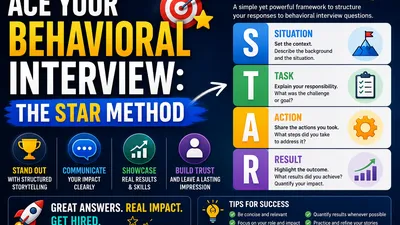
As software engineers, we spend countless hours grinding LeetCode, designing systems, and mastering frameworks. But when it comes to the behavioral interview, many of us freeze. We ramble, overshare, or give vague answers about "we did this" and "the team did that."
Here is the hard truth: Behavioral interviews are just as rigorously evaluated as technical ones. Companies like Amazon and Google explicitly use behavioral rounds to filter out brilliant jerks and identify engineers who can actually ship code collaboratively.
The universal framework for crushing these interviews is the STAR Method. But knowing what the acronym stands for is not enough—you need to know how to wield it like a scalpel.
Here is the definitive guide to mastering the STAR method for tech interviews.
What is the STAR Method?
STAR is a structured way to respond to behavioral questions (those starting with "Tell me about a time..." or "Give me an example of...").
- S - Situation: Set the scene. Provide context.
- T - Task: What was your specific goal or problem?
- A - Action: What specific steps did you take? (The most important part).
- R - Result: What was the outcome? (Must be quantifiable).
graph LR
    S[Situation
 10% of answer] --> T[Task
 10% of answer]
    T --> A[Action
 60% of answer]
    A --> R[Result
 20% of answer]

    style A fill:#4CAF50,color:#fff,stroke:#333
    style R fill:#2196F3,color:#fff,stroke:#333
Notice the percentages. The biggest mistake candidates make is spending 80% of their time on the Situation and Task, leaving almost no time for the Action and Result. Your interviewer only cares about what you did and the impact it had.
Let's break down each component.
Deconstructing the STAR Framework
S - Situation (The Context)
Don't over-explain. Give just enough background so the interviewer understands the environment. * Bad: "Well, the company was founded in 2015, and we use React, and the team was 10 people, and it was raining..." * Good: "Our team was tasked with migrating a legacy monolithic payment service to a microservices architecture."
T - Task (Your Responsibility)
Clarify your specific role. What was the problem you were trying to solve? * Bad: "We had to fix the bugs." * Good: "I was the tech lead responsible for ensuring zero downtime during the database migration phase, while still allowing the frontend to read from the old schema."
A - Action (The Meat)
This is where you earn your score. You must speak in the first person ("I", not "We"). Interviewers are hiring you, not your team. * Focus on the "How": Don't just say "I wrote a script." Say, "I wrote a Python script using Boto3 to automate the AWS Lambda deployments, which eliminated manual human errors." * Highlight technical tradeoffs: "I chose Redis over Memcached for this caching layer because we needed data persistence, even though it meant slightly higher memory overhead." * Navigate the people: Technical problems often involve human friction. Mention how you aligned the PM, pushed back on scope creep, or helped a junior engineer.
R - Result (The Impact)
End with a punch. Vague results mean nothing. You need hard numbers, percentages, or explicit business outcomes. * Bad: "It worked really well and the team was happy." * Good: "The migration completed 2 days ahead of schedule, p95 latency dropped by 40%, and we had zero dropped requests during the cutover."
🔥 Pro Tip: Add the "+L" (Learning) Sometimes, the result isn't a success, or it's a lesson learned. Adding "Learning" to the end shows maturity and self-awareness. "While we hit the deadline, I realized I didn't communicate the API changes well enough to the mobile team, causing a minor integration bug. Since then, I've enforced contract testing using Pact in my CI pipelines."
STAR in Action: A Real Example
Question: "Tell me about a time you had a conflict with a teammate."
❌ Weak Answer (Rambling, "We", No Impact):
"We had a junior dev on the team who kept writing bad code. Like, really bad. No tests, terrible variable names. We had a big sprint coming up and it was slowing us down. We had a meeting with the manager and told him he needed to step it up. It got kind of awkward, but eventually, his code got better and we finished the sprint."
✅ STAR Answer (First-person, Technical depth, Quantifiable):
(Situation): "On my last project, we were two weeks from a major release, and our PR review times were ballooning to 48 hours because one of our mid-level engineers was pushing massive, monolithic PRs without any unit tests."
(Task): "As the informal tech lead, I needed to help him improve his PR quality without destroying his confidence right before a high-pressure deadline."
(Action): "Instead of criticizing in the public PR thread, I set up a 1-on-1 pairing session. I learned he was struggling with our mocking framework, which caused him to skip tests. I walked him through how to use pytest fixtures to mock our DB calls. I also suggested we implement a pre-commit hook using Husky to run linters locally, so he'd catch syntax errors before pushing. Finally, we agreed to a team standard of max 400 lines per PR."
(Result): "Within a week, his PR sizes dropped by 60%, and our review turnaround time improved from 48 hours to under 12. We hit our release on time, and he actually thanked me for the pairing session. It taught me that poor code quality is often a tooling or knowledge gap, not an attitude problem."
Building Your "Story Bank"
Do not try to invent stories on the fly. Before your interview, build a matrix of 5-7 versatile stories that can answer multiple types of questions.
| My Story | Conflict | Failure/Mistake | Tight Deadline | Leadership/Initiative | Technical Challenge |
|---|---|---|---|---|---|
| 1. The Production Outage | ✅ | ✅ | ✅ | ||
| 2. Pushing back on PM scope | ✅ | ✅ | ✅ | ||
| 3. The Failed Migration | ✅ | ✅ | |||
| 4. Mentoring the Junior Dev | ✅ | ✅ |
If the interviewer asks about a time you failed, you pull out Story #3. If they ask about a technical challenge, you pull out Story #1 or #3. You don't need 50 stories; you need a few deep, multi-faceted ones.
The 3 Golden Rules of Behavioral Interviews
- Never say "We": If you catch yourself saying "We decided," immediately correct it to "I recommended, and the team agreed." The interviewer is grading your individual contribution.
- Never say "I would": Behavioral questions ask about the past, not the hypothetical future. "I would do X" is a fail. "I did X" is a pass.
- Pause and Map: When asked a question, don't start talking immediately. Take 3-5 seconds to think: Which of my 5 banked stories fits this best? Say, "That's a great question, let me think of a specific example." Interviewers appreciate the thoughtfulness.
Behavioral interviews aren't trying to trick you. They are simply asking: Are you an engineer who can write code, communicate, and deliver impact in a messy, human environment?
Use STAR, lean on your quantifiable results, and you'll turn your past experiences into future offers.